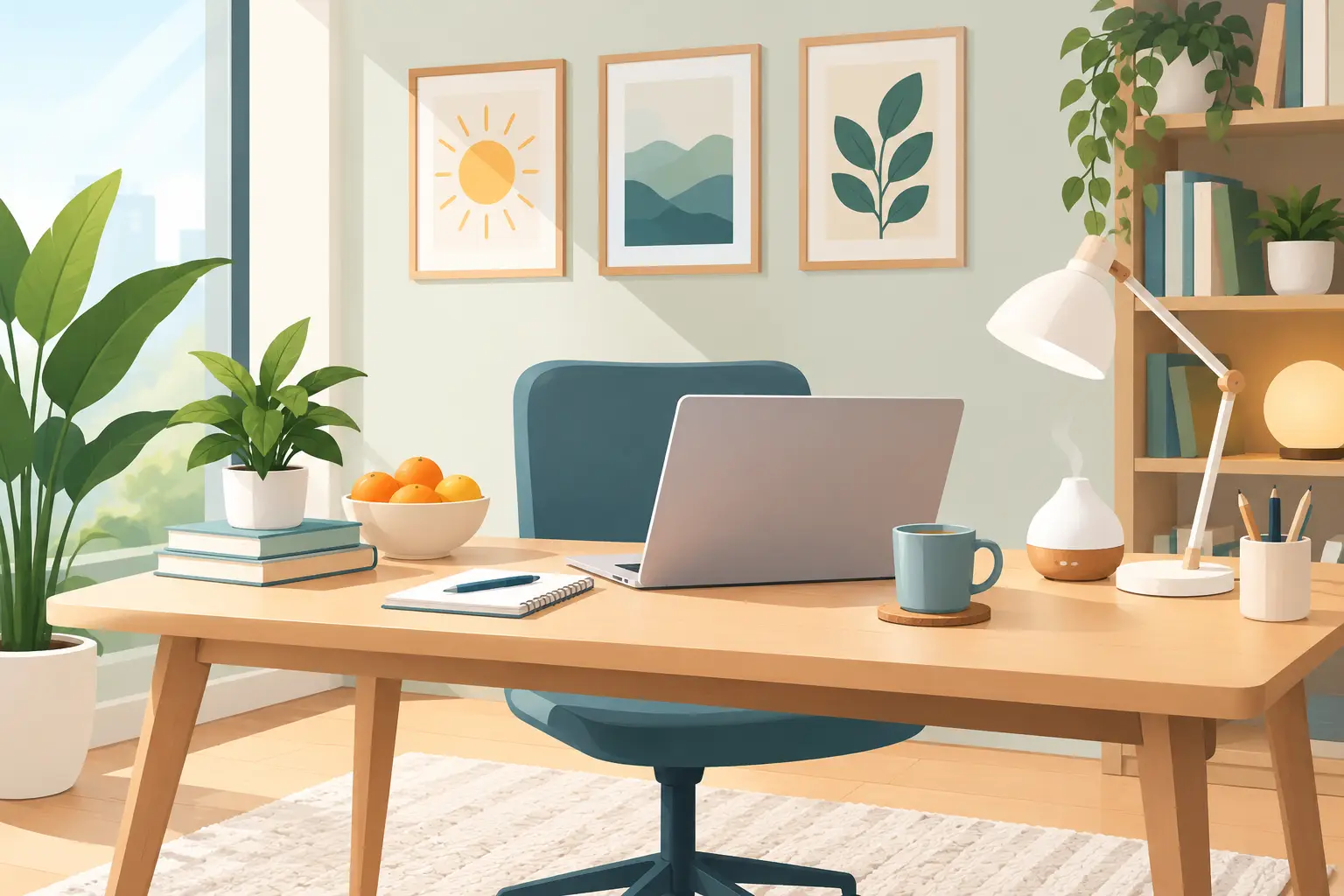
11 Best Home Office Mood Boosters That Work

Your home office has heard every version of you: focused you, snack-motivated you, and the version who says, “quick question,” while opening a tab that absolutely should have been an email. The best home office mood boosters do not need to turn your workspace into a wellness retreat with a waiting list. They just need to make the hours at your desk feel a little more human.
A better mood at work is rarely about one heroic purchase. It is usually the result of small signals that tell your brain: this is a place where I can think, move, make coffee, and perhaps survive the meeting that could have been a Slack message. Here are the upgrades worth considering.
The best home office mood boosters start with your senses
1. Light that does not feel like an interrogation
Bad lighting can make an otherwise decent room feel like a basement office from 2004. If your desk can face or sit near a window without putting glare directly on your screen, natural light is the easiest win. It helps separate morning from afternoon and makes the room feel less static.
No useful window? Add a warm desk lamp rather than relying on one harsh overhead fixture. Look for a bulb that gives clear task lighting without making your face look like it is being questioned by airport security. Cooler light can help some people feel alert in the morning, while warmer light often makes late-day work feel calmer. The right answer depends on your room and your tolerance for being perceived by your webcam.
2. One plant with realistic expectations
A plant adds color, shape, and a tiny bit of life to a desk setup full of rectangles. That matters more than it sounds. Looking away from a screen at something green is a small visual reset, especially when your spreadsheet has begun to look emotionally personal.
Choose based on your actual behavior, not the person you imagine becoming. A pothos, snake plant, or ZZ plant is usually more forgiving than a needy little botanical diva. If your office gets no light and you have a history of forgetting living things, a convincing faux plant is not a moral failure. It is interior design with boundaries.
3. A coffee or tea ritual that has a beginning and an end
The drink itself is nice. The ritual is doing a lot of the heavy lifting. Making coffee before work, refilling your water at midday, or brewing tea after a difficult call creates a clean pause between tasks.
Use a mug you genuinely like, ideally one that recognizes the absurdity of professional life without shouting it across the room. A dry little joke can be surprisingly effective when you are on hour three of “circling back.” It is not productivity science. It is a small vote for personality.
4. A playlist with no emotional jump scares
Music can lift the atmosphere quickly, but it needs to fit the task. Lyrics may be perfect for email, admin, or chores, yet deeply unhelpful when you are writing, coding, or trying to understand a chart made by someone who hates labels.
Build a few reliable options instead of hunting for something new every day: instrumental music for concentration, familiar upbeat music for repetitive work, and ambient sound for afternoons when your brain has quietly left the building. Keep the volume low enough that it supports the room rather than becoming the room.
Mood boosters for a home office that feels like yours
5. A desk surface with some personality
A desk is not required to be beige, blank, or emotionally neutral. A mouse mat, coaster, notebook, or small desk sign can make it feel less like borrowed real estate. The trick is choosing one or two pieces that make you smirk, rather than covering every available inch in motivational quotes and cable adapters.
This is where a sarcastic desk accessory earns its keep. A clean, high-contrast mouse mat from SarkyJoe, for example, gives the eye something better to land on than another unopened notification. It is a tiny mood shift, not a life coach in a font you regret.
6. Fewer visible cables and fewer tiny annoyances
Clutter does not ruin everyone’s mood, but visual friction is real. A tangled charging cable, a stack of mystery papers, and six pens that do not work can create a low-grade sense that the day is already getting away from you.
You do not need a showroom desk. Give the essentials a home, hide or clip the most obvious cables, and clear enough space to set down a notebook or lunch. Leave one useful item within reach, then remove the rest of the supporting cast. The goal is not minimalism as a personality. The goal is fewer things silently asking for your attention.
7. Something that smells good, but not aggressively good
Scent can make an office feel distinct from the rest of your home, which is especially helpful if your commute is now six feet and a cat. A lightly scented candle, diffuser, or room spray can signal the start of a work block or the end of one.
Go easy. Heavy fragrance can become distracting or irritating fast, particularly in a small room. Citrus, light wood, mint, or soft coffee scents tend to feel fresh without turning your desk into a department store candle aisle. If you share the space, choose something neutral or skip scent entirely. Your favorite candle should not become someone else’s migraine origin story.
8. A seat and screen position your body can tolerate
It is difficult to feel cheerful when your neck has been negotiating with your laptop all day. Ergonomics may not sound glamorous, which is exactly why people ignore it until their shoulders begin sending formal complaints.
Raise your screen so you are not constantly looking down. Support your lower back, keep your feet stable, and use an external keyboard or mouse if you work on a laptop for long stretches. You do not have to buy a futuristic chair that looks like it was designed for a moon base. Small adjustments can be enough, especially when paired with regular movement.
The mood boosters that happen away from the desk
9. A five-minute reset that actually removes you from work
The fastest way to make a home office feel oppressive is to treat every break as a chance to scroll through more information. Instead, step outside, fold laundry, water the plant, stand by a window, or walk to the end of the block.
The activity does not need to be noble. It simply needs to be different from staring at your screen. A short physical reset helps your brain mark a transition, which makes returning to work less irritating than trying to power through for six uninterrupted hours. Nobody wins that contest, including your posture.
10. A visible plan for the next task
Uncertainty has a way of making even easy work feel heavy. Before you finish for the day, write down the first one or two things you will do tomorrow. Keep it simple and specific: review project notes, send the draft, outline three ideas. “Fix everything” is not a task. It is a cry for help.
A short list makes the next morning easier because you do not have to begin by deciding where to start. That reduction in mental clutter can be a bigger mood booster than another desk gadget, although desk gadgets are still allowed to have their little moment.
11. A proper end-of-day signal
When your office is at home, work can smear itself across the evening if you let it. Closing the laptop, putting it in a drawer, switching off the desk lamp, or changing into a T-shirt that is not vaguely acceptable for video calls can create a clear finish line.
This is particularly useful if you work in the same room where you relax. Your brain needs evidence that the workday has ended. Otherwise, every glance toward the desk becomes a reminder of something unfinished, which is rude behavior from furniture.
Do not buy your way around a broken routine
There is a limit to what a new lamp, better mug, or very funny mouse mat can fix. If your workload is unreasonable, your boundaries are nonexistent, or you have not left the house in “years,” the bigger issue may not be the desk. Mood boosters work best when they support habits that give you room to breathe.
Start with the change that annoys you most right now. If the room feels grim, fix the light. If the desk feels chaotic, clear the surface. If every day runs together, create a coffee ritual and a shutdown ritual. You do not need an office that looks impressive online. You need one that makes sitting down tomorrow feel slightly less like a personal betrayal.
Comments